
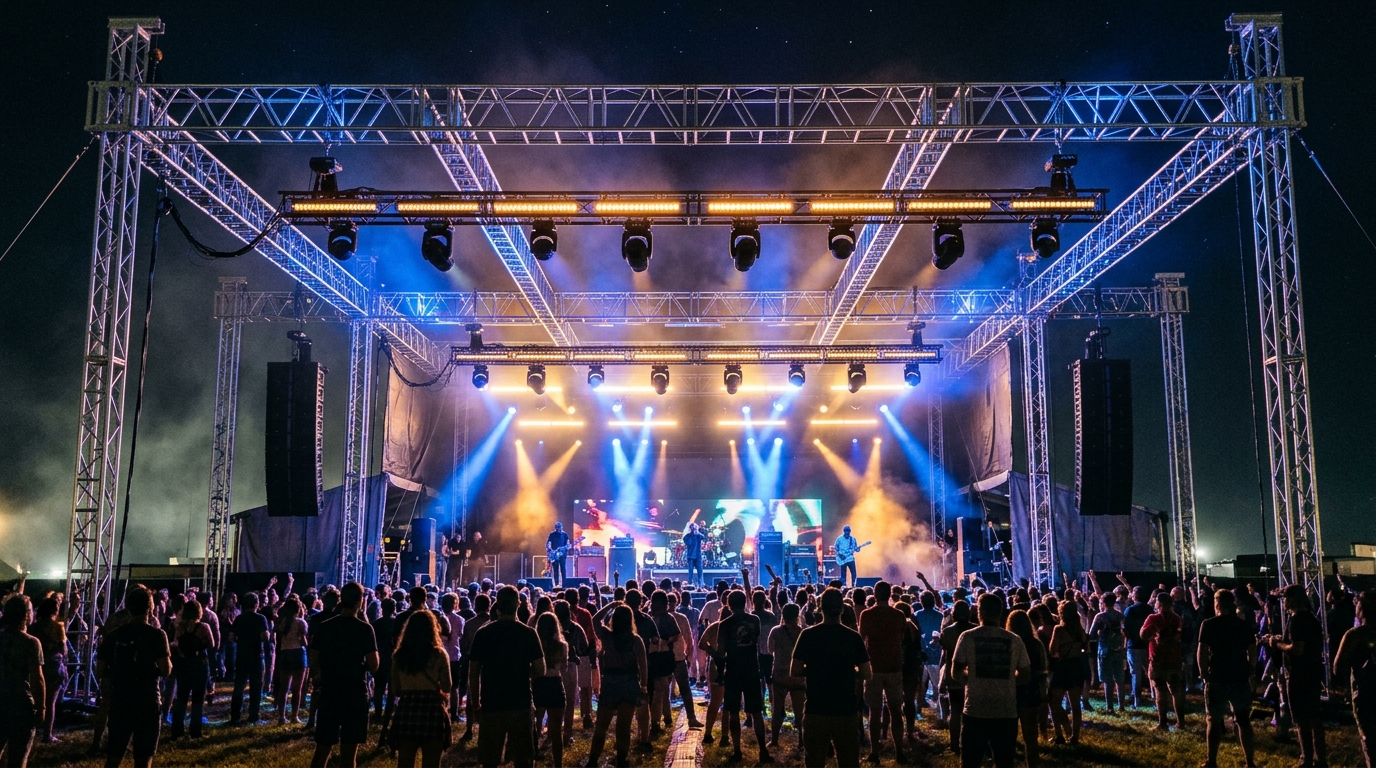
1. Match Outdoor LED Stage Lights to Your Event Type & Stage Scale
Outdoor lighting faces unpredictable rain, airborne dust, humidity swings, wind load, and temporary generator power—challenges indoor rigs never see. Choosing the wrong fixtures leads to dim faces on camera, moisture condensation inside lenses, tripped breakers, and mid-show failures. Before comparing fixture datasheets, lock down the visual scope and throw distance for your event type (or review our outdoor concert lighting field case study for wide-stage reference).
Music Festivals & Touring Concerts
Large open-air stages (12 m–24 m wide) demand long-throw punch that stays visible against high-nit LED video walls. Pair IP66 aerial beam moving heads with high-output LED Bee-Eye washes, 800W+ framing profiles for performer keying, and IP65/IP66 linear strobe bars managed over Art-Net or sACN.
Outdoor Weddings & Courtyard Private Galas
Intimate gatherings prioritize clean aesthetics, quiet fan operation, and flattering skin tones under 2700K–3200K warm white or soft RGBW washes. Compact IP65/IP67 LED PARs, COB front lights, and low-profile wash moving heads illuminate dining tents, pathways, and trees without intrusive truss towers.
Corporate Events, Civic Plazas & Broadcast Stages
Brand launches and outdoor civic ceremonies require uniform presenter visibility and broadcast-ready video streams. Prioritize high-CRI (CRI 90+) outdoor front washes and framing profile spotlights to eliminate harsh shadows and prevent light spill onto presentation screens.
| Event & Stage Scale | Recommended Fixture Mix | Target IP & CRI | Power & Control Baseline |
|---|---|---|---|
| Small Patio / Wedding (< 8 m) | 6–12× IP65/IP67 PARs + 2–4× COB Front Lights + 2× Compact Washes | IP65/IP67 · CRI 90+ front light | 1–2× 16A/20A circuits · DMX512 / CRMX |
| Corporate Stage / Plaza (8–14 m) | 4× Front Washes + 2–4× Framing Profiles + 8× IP65 PAR Uplights | IP65 · CRI 90+ · 3,000 Hz+ PWM | 3-phase disto (20–30% headroom) · DMX/RDM |
| Festival / Concert Stage (14–24 m+) | 8–16× IP66 Beams + 8–12× Bee-Eye Washes + 4–6× Profiles + Strobes | IP65/IP66 · 1.7°–2.5° beam + zoom wash | Dedicated generator + Art-Net / sACN fiber |
2. IP Rating Explained: IP65 vs. IP66 and Full-System Weatherproofing
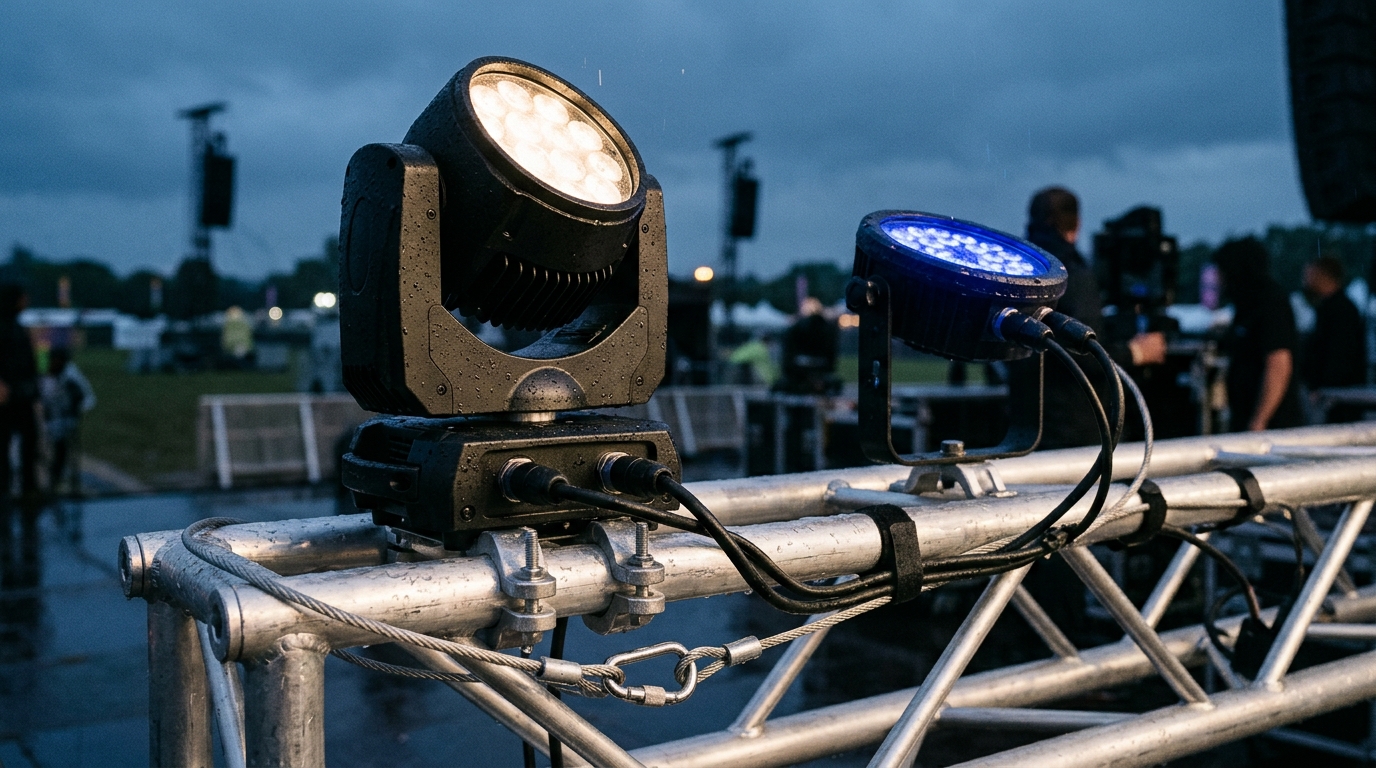
An IP (Ingress Protection) code uses two digits: the first rates solid/dust protection (0–6, where 6 is completely dust-tight) and the second rates liquid protection (0–8). For outdoor events, never rely on indoor IP20 fixtures wrapped in improvised plastic bags, which trap heat and moisture.
However, an IP65 or IP66 label on the datasheet is only the starting point. Real-world outdoor reliability depends on five mechanical and environmental details:
- True IP65/IP66 Connectors: Ensure every unit uses locking waterproof powerCON True1-style AC in/out and sealed 3-pin or 5-pin XLR/etherCON jumpers—and cap unused output sockets with rubber dust/water boots.
- Gore-Tex Pressure-Equalization Breathers: Rapid temperature drops after sunset pull humid air past gaskets into hot housings, fogging inner lenses. Quality outdoor fixtures integrate hydrophobic pressure-relief vents to stop internal condensation.
- Salt-Spray & Corrosion Resistance: For coastal resorts or humid seasons, choose die-cast aluminum or magnesium-alloy housings with marine-grade powder coating and stainless-steel fasteners.
- Ambient Operating Window: Confirm tested limits (typically -10°C to +45°C) so power supplies neither overheat under afternoon sun nor stall during cold night load-ins.
- Rigging Orientation & Drip Loops: Route power and DMX jumpers with downward drip loops before entering rear sockets so rainwater runs off the cable rather than pooling against sealing rings.
| IP Rating | Dust & Water Protection | Outdoor Stage Suitability |
|---|---|---|
| IP20 | No water protection; finger-safe only | Indoor venues only; never expose to rain, fog spray, or outdoor dew |
| IP44 / IP54 | Limited splash protection only | Covered pavilions or under deep stage roofs; vulnerable to wind-driven rain |
| IP65 | Dust-tight (6) + low-pressure water jets (5) | Solid baseline for outdoor weddings, corporate events, and light-to-moderate rain |
| IP66 | Dust-tight (6) + powerful directional water jets (6) | Recommended standard for open-air festivals, coastal stages, and heavy rain |
| IP67 | Dust-tight (6) + temporary immersion up to 1 m | Ground-level architectural uplights and PARs exposed to standing puddles |
3. Essential Types of Outdoor Waterproof LED Stage Lights
Explore YL Light’s full Outdoor IP-Rated Stage Lights & Moving Heads lineup to match each fixture category below to its exact role in your rig:
3.1 Waterproof LED PAR & COB Front Lights
Waterproof PARs provide affordable stage uplighting, truss warming, and architectural perimeter accents. Use compact units like the 18 x 10W LED Outdoor IP65 PAR Light for RGBW washes on trees and backdrops, or step up to the 4-Eye COB LED Outdoor IP67 PAR Front Light when ground-mounted fixtures sit in puddles or wet grass and need punchy audience blinders or front fill.
3.2 Outdoor LED Moving Head Lights: Beam, Profile, Wash & Hybrid
Moving heads drive the dynamic energy of an outdoor production and break down into four distinct optical engines:
- Beam Moving Heads (1.7°–2.5°): Engineered for sharp aerial columns that slice across festival skies. Models such as the 380W / 420W Outdoor IP66 Prism Beam Moving Head deliver dual-prism aerial looks; compare discharge options in our 380W vs 420W IP66 Beam Moving Head Outdoor Buying Guide.
- Framing Profile Moving Heads: Precision 4-blade or 8-blade shutters cut clean edges around speakers and lecterns while keeping spill off video walls—exemplified by the 800W IP66 LED Profile Moving Head with 4-Blade Framing.
- Hybrid Beam-Spot-Wash (BSW): Ideal for rental fleets seeking multi-role flexibility. Compare all-LED versatility in the LS-600 500W LED Outdoor IP65 Beam Spot Wash Moving Head or intense long-throw lamp punch in the 450 BSW IP Outdoor IP66 Beam Spot Wash Moving Head with CMY.
3.3 Outdoor LED Wash & Bee-Eye Lights
Wide motorized zoom washes evenly illuminate performers, bands, and scenic backdrops without harsh hotspots. Pair multi-cell effects like the 19 x 40W RGBW LED Outdoor IP65 Bee Eye Moving Head (or 37×40W models for massive stages) with camera-accurate front lighting such as the M600 LED Outdoor IP65 Moving Head Front Light, CRI 90+.
3.4 Outdoor LED Strobe & Moving Bar Lights
For EDM drops, rock accents, and synchronized truss kinetics, combine high-output blinders like the 1400W LED Outdoor IP65 Moving Head Strobe Wash Light with pixel-mappable tilt bars such as the TB5 5 x 120W RGBW Outdoor IP66 Moving Head Bar Light. Always program strobe duty cycles responsibly to respect audience comfort and photosensitivity guidelines.
- Outdoor IP-Rated Stage Lights & Moving Heads
- 18 x 10W LED Outdoor IP65 PAR Light
- 4-Eye COB LED Outdoor IP67 PAR Front Light
- 380W / 420W Outdoor IP66 Prism Beam Moving Head
- 800W IP66 LED Profile Moving Head with 4-Blade Framing
- LS-600 500W LED Outdoor IP65 Beam Spot Wash Moving Head
- 450 BSW IP Outdoor IP66 Beam Spot Wash Moving Head with CMY
- 19 x 40W RGBW LED Outdoor IP65 Bee Eye Moving Head
- M600 LED Outdoor IP65 Moving Head Front Light, CRI 90+
- 1400W LED Outdoor IP65 Moving Head Strobe Wash Light
- TB5 5 x 120W RGBW Outdoor IP66 Moving Head Bar Light
- 380W vs 420W IP66 Beam Moving Head Outdoor Buying Guide
4. Brightness, Beam Angle, Photometrics & Camera Readiness
Never buy outdoor stage lights on rated wattage alone. Two 400W fixtures with different optical designs and front-lens diameters can differ by 2×–3× in usable illuminance at 20 meters. Always inspect manufacturer photometric charts—see our guide on reading stage lighting photometric data before you buy—and check three quantitative metrics:
- Lux at Working Distance (10 m / 20 m / 30 m): Measure footcandles or lux at your real truss-to-stage throw distance and beam zoom setting, not just at 3 meters on a tight spot.
- Beam Angle Tiers: Tight 1.7°–2.5° angles maximize aerial beam visibility in open air; medium 6°–25° spots/profiles key performers cleanly; wide 15°–55° zoom washes cover bands and stages smoothly without dark patches.
- Broadcast & Livestream Readiness (CRI & PWM): Outdoor events are almost always filmed on smartphones, cinema cameras, or IMAG LED walls. Ensure front-light washes deliver CRI ≥ 90 for natural skin tones and selectable high-frequency flicker-free PWM (3,000 Hz–16,000 Hz+) to prevent rolling shutter banding.
5. Professional Control Systems: DMX512, RDM, Art-Net, sACN & Wireless DMX
Reliable signal distribution across long outdoor cable runs separates smooth shows from flickering fixtures:
- DMX512 with Opto-Splitters & Terminators: Never run more than 32 fixtures on a single passive daisy-chain or exceed ~300 meters without optically isolated DMX splitters. Always place a 120 Ω DMX terminator on the final fixture of every line to block signal reflections.
- RDM (Remote Device Management): RDM-enabled outdoor heads save hours on rain-soaked trusses by letting FOH engineers inspect internal housing temperatures, lamp/LED hours, and DMX addresses remotely from the console.
- Art-Net & sACN Networking: Large pixel-mapped washes, Bee-Eye rings, and moving bars consume hundreds of DMX channels per truss. Distribute universes over waterproof etherCON or tactical fiber runs to truss-mounted Art-Net/sACN nodes.
- Wireless DMX (CRMX) Deployment: Wireless transceivers simplify uplighting across gardens, courtyards, and distant architectural trees. Elevate transmitters above crowd height for clean line-of-sight, scan crowded 2.4 GHz festival Wi-Fi bands, and always keep wired DMX backup on main stage trusses.
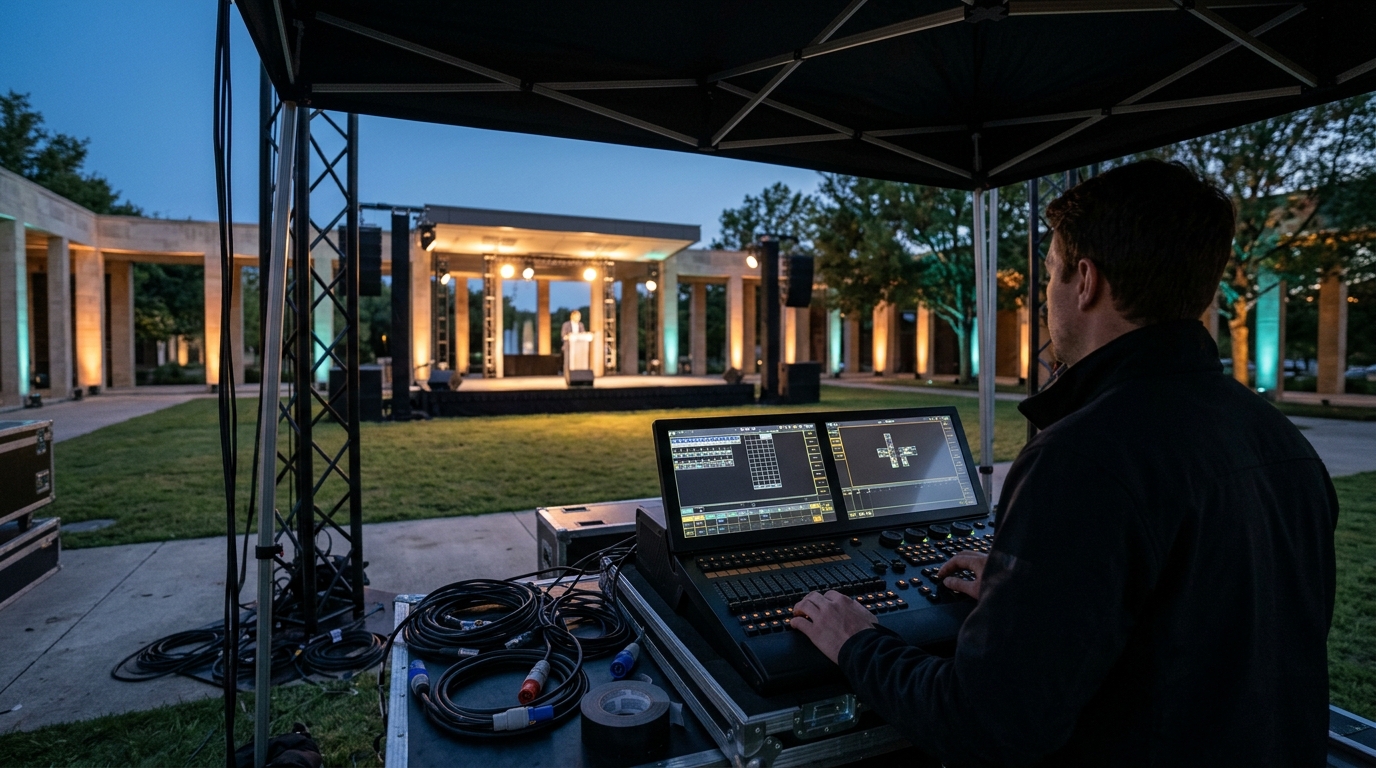
6. Power Distribution, Generator Sizing, Thermal Design & Rigging Safety
Outdoor shows run on temporary power and exposed aluminum structures, making electrical math and mechanical rigging non-negotiable:
- Calculate Continuous Circuit Load: Use Amps = Total Watts ÷ Voltage × 1.25 (e.g., 4,000 W total load at 220 V draws ~18.2 A nominal and requires at least ~23 A continuous capacity). Never load any single AC circuit or powerCON daisy-chain past 80% of its rated breaker.
- Generator Headroom & Pure-Sine Power: Size portable or towable generators with 20%–30% spare capacity above peak lighting + audio draw, verify AVR (automatic voltage regulation) and clean grounding, and avoid unconditioned square-wave generators that damage switch-mode LED power supplies.
- Sealed Thermal Dissipation: IP65/IP66 units cannot pull outside air across electronics. Look for cast-aluminum finned heatsinks, internal circulation fans, and smart thermal throttling so fixtures survive hot afternoon soundchecks.
- Wind Load, Clamps & Safety Bonds: Verify truss wind-speed limits, account for fixture weight (heavy IP66 profiles and hybrids often weigh 25–42 kg), mount every hanging unit with two rated omega clamps, and attach an independent galvanized steel safety wire rated well above the fixture’s dynamic weight.
7. 6 Costly Mistakes to Avoid When Buying Outdoor LED Stage Lights
Rental houses and event organizers frequently lose budget and show reliability to six preventable errors:
- Putting indoor IP20 lights under makeshift rain domes: Plastic covers restrict airflow, trap humid condensation, and expose rear connectors during wind gusts.
- Buying by wattage instead of photometric lux and optics: A high-wattage fixture with poor optical transmission gets washed out next to LED video screens.
- Pairing IP66 fixtures with non-waterproof jumper cables: Water tracks straight through unsealed AC/DMX plugs and shorts internal boards.
- Over-investing in narrow beams while starving front wash light: Aerial columns look impressive in wide shots, but performers remain dark on camera without dedicated high-CRI front wash and framing profiles.
- Ignoring pressure breathers and coastal corrosion specs: Salt air and evening temperature swings quickly fog lenses and seize tilt locks on unsealed hardware.
- Skipping generator headroom, cable ramps, and spare fixtures: Always budget waterproof cable crossovers, 10% spare units on tour, and a clean 25% power buffer.
8. Final Buying Checklist & Next Steps
Choosing the right outdoor LED stage lights comes down to matching verified weather protection (IP65 for general outdoor events, IP66 for open-air festivals and heavy rain) with real throw-distance photometrics, camera-safe CRI 90+ / flicker-free PWM front light, RDM/Art-Net network control, and disciplined generator and rigging margins.
Before placing an order, prepare your stage width, truss trim height, throw distance, local mains/generator voltage, and camera requirements. Browse YL Light Outdoor IP65/IP66 Stage Lighting or request a tailored outdoor lighting configuration, photometric files, and quotation from our engineering team.
9. Frequently Asked Questions (FAQ)
01Is IP65 or IP66 better for outdoor LED stage lighting?
IP65 protects against dust and low-pressure water jets, making it reliable for weddings, corporate patios, and light rain. IP66 withstands powerful directional water jets and wind-driven downpours, making IP66 the preferred choice for open-air music festivals, coastal venues, and multi-day touring stages.
02How many outdoor LED stage lights do I need for a 10-meter stage?
A practical 10 m outdoor stage baseline pairs 4× IP65 front wash or framing profile lights for crisp performer visibility, 6–8× waterproof wash/Bee-Eye heads or IP65 PARs for stage color and backdrop depth, and 4–6× IP66 beam or hybrid moving heads for aerial effects—adjusted based on truss height and surrounding ambient light.
03Can outdoor LED moving heads run safely on a portable generator?
Yes, provided you use an inverter or AVR-regulated pure-sine generator sized with at least 20%–30% headroom above total continuous wattage, proper earth grounding, and balanced phase distribution to prevent voltage sags during full-bright white cues.
04How do you prevent condensation inside outdoor waterproof stage lights?
Choose fixtures engineered with hydrophobic Gore-Tex pressure-equalization breathers, keep waterproof caps on unused sockets, avoid sealing hot fixtures inside damp flight cases immediately after rain, and run a low-intensity warm-up cue during humid dusk load-ins.
05Why do CRI 90+ and flicker-free PWM matter for outdoor stage lighting?
Outdoor concerts and corporate speeches are captured by broadcast cameras, IMAG LED screens, and audience phones. CRI 90+ prevents dull or greenish skin tones on front light, while selectable 3,000 Hz–16,000 Hz+ PWM eliminates rolling flicker bars on video.
Read this guide in your language