
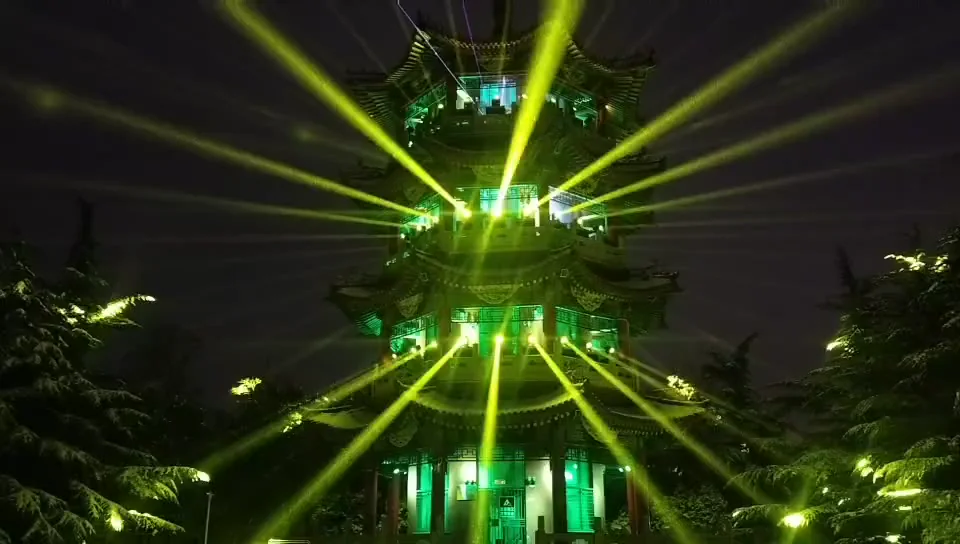
Use beam lights to create controlled lines, fans and movement around a building, and wash lighting to reveal surfaces and architectural layers. Plan them as separate groups, then coordinate colour, intensity and timing. Choose each fixture's protection rating and operating conditions for its actual installation position.
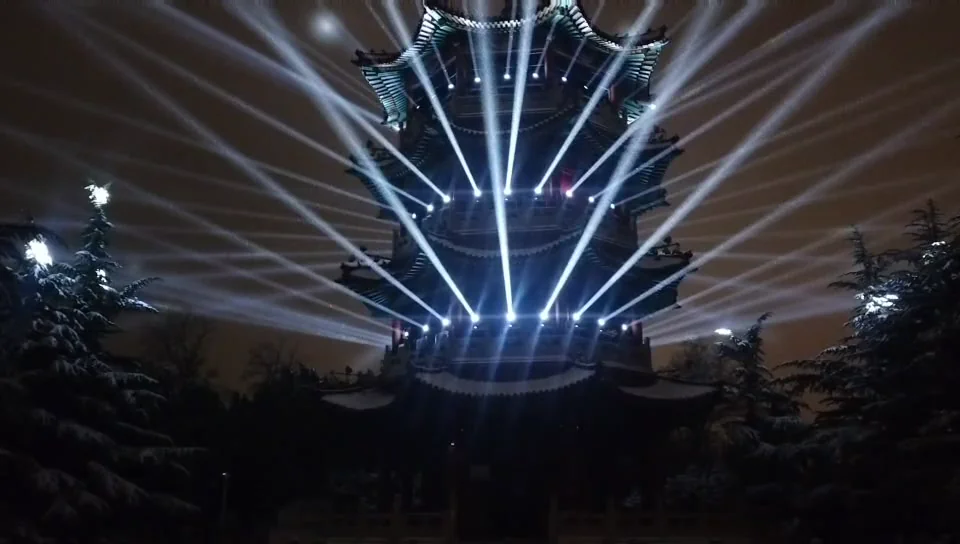
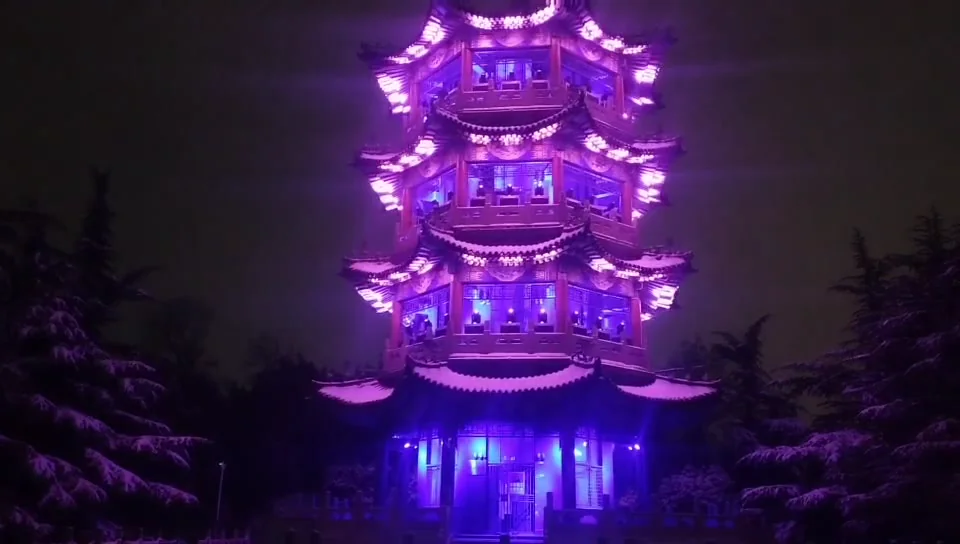
The supplied footage from Shanxi, China, shows a tiered pagoda-style building changing between purple and blue surface lighting, white beam arrays and yellow-green aerial effects. The strongest scenes give the building a readable shape while adding movement around it.
YL Light has identified the beam fixtures for this application as the 550W model. The 19 × 40W outdoor RGBW wash discussed below is a catalogue option for a comparable design; it is not presented as a confirmed equipment list for the filmed building.
Read this article in your language
1. Let the architecture set the lighting hierarchy
Divide the building into elements such as entrances, columns, balconies, roof edges and upper tiers. Decide which elements should remain visible during a quiet scene and which should appear only during a show cue. A tall building needs a clear relationship between its lower, middle and upper levels.
Broad colour coverage can make these layers readable. Narrow beams add direction and scale. If every layer moves, changes colour and reaches full intensity at once, the architecture can become harder to read. Review the design from the main viewing positions, not only from beside the fixtures.
2. Give beam and wash different jobs
| Design task | Beam lighting | Wash lighting |
|---|---|---|
| Primary role | Defined lines, fans, aerial patterns and timed accents. | Colour coverage on surfaces and a consistent visual base. |
| Selection priority | Beam angle, focus, effects and the permitted movement area. | Coverage at the actual distance, colour mixing, zoom and spill control. |
| Commissioning check | Aim and movement limits from every public viewing direction. | Hotspots, gaps, unwanted spill and balance between building levels. |
Architectural lighting in Shanxi — supplied application footage
3. Use the 550W IP66 beam for structure and movement
The YL Light 550W BEAM IP66 has 550W total rated power and a 380W USHIO NSLU6C lamp. Its published beam angle is 1.7°, with motorized focus, independent frost, 8-facet and 24-facet prisms, and 16-channel DMX512 control.
For an architectural show, group beam positions by level or side of the building. Program symmetrical fans, controlled crossings or a gradual reveal from the lower tiers upward. Establish permitted pan and tilt ranges before adding movement. Keep direct light away from viewers, neighbouring windows and traffic.
The visible beam in a recording depends on the air, background and camera exposure. Use the video as a reference for composition and sequencing; confirm throw, visibility and output through a site demonstration.
4. Use outdoor RGBW wash to reveal surfaces
For a comparable colour layer, the Mini 19 × 40W RGBW Outdoor Zoom Wash with LED Ring and Pixels offers a published 4–60° zoom range, RGBW colour mixing and DMX512/RDM control. Its rated power is 800W and its published protection rating is IP65.
Use a wider setting where a surface needs broad coverage and a narrower setting where light must stay within a smaller architectural element. Adjust position, aim, zoom and intensity together. Dark material, reflective finishes, recesses and roof overhangs can all change the apparent result.
This wash model and the 550W beam have different protection ratings: IP65 and IP66 respectively. If a specification requires IP66 at every mounting position, request a verified IP66 wash alternative before finalizing the equipment schedule.
5. Build a quiet scene before the show sequence
Start with a restrained scene that keeps the entrance and main architectural layers legible. Then create a limited set of show cues around that base. The following is a planning example, not a reconstruction of the video's control program.
| Scene | Wash layer | Beam layer |
|---|---|---|
| Architectural night scene | A balanced palette with steady or slow-changing intensity. | Off, or a restrained accent within the approved aiming area. |
| Layered reveal | Bring in lower, middle and upper levels in sequence. | Follow the reveal with deliberate, measured movement. |
| Show highlight | Hold a clear base colour so the building remains visible. | Add a coordinated fan or crossing, then return to the quieter scene. |
6. Specify the outdoor installation as a complete system
An IP rating describes enclosure protection under defined test conditions. IP66 indicates dust-tight protection and resistance to powerful water jets; IP65 covers dust-tight protection and water jets. Neither rating alone establishes suitability for immersion, every climate or continuous permanent operation.
Check the manufacturer's operating temperature, duty requirements, mounting orientation, cable entries, connectors, power distribution and maintenance access. The published operating range for this 550W beam is −10°C to 40°C. Compare it with the actual seasonal conditions at the site, including startup conditions.
Agree beam boundaries, operating hours and a low-intensity or blackout state with the project team. For a building with heritage restrictions, obtain approval for mounting and cable routes before installation. Final fixture positions and electrical arrangements should be designed and checked by the responsible professionals.
7. Send a useful architectural lighting brief
A quotation becomes more useful when the supplier can see both the desired effect and the physical constraints. Send:
- Building dimensions, elevations, photos and the areas that should be highlighted.
- Proposed mounting positions, aiming distances and main public viewing positions.
- Everyday lighting scenes, show duration, cue references and operating hours.
- Outdoor temperatures, exposure, required IP rating and installation restrictions.
- Existing control system, power supply, cable routes and maintenance access.
- Required quantity or design scope, destination and delivery schedule.
Use a sample installation or an agreed test area to assess coverage, colour transitions, movement limits and the camera view before approving a complete package.
Frequently asked questions
01Can a beam light replace a wash light on a façade?
A narrow beam is designed for a defined effect. Even with frost, its coverage and colour behaviour must be checked for the intended surface. A suitable wash is usually the more direct starting point for broad colour coverage; use the beam as a separate effect layer.
02Does IP66 make a fixture suitable for every permanent outdoor project?
No. Confirm temperature limits, installation method, connectors, duty cycle and servicing as well as ingress protection. Site conditions and the manufacturer's instructions determine whether a model is appropriate.
03How many fixtures does a pagoda or tower need?
There is no reliable count based only on building height or a video. Fixture quantity depends on the geometry, mounting distances, optics, surface finishes, target appearance and ambient light. Start with a layout and validate it with relevant photometric data and a site test.
Product information and reference
Plan your architectural lighting package
Send YL Light your building photos, dimensions, installation positions and preferred show style. We can discuss the 550W IP66 beam and an outdoor wash option with clearly identified specifications and the checks needed for your project.