
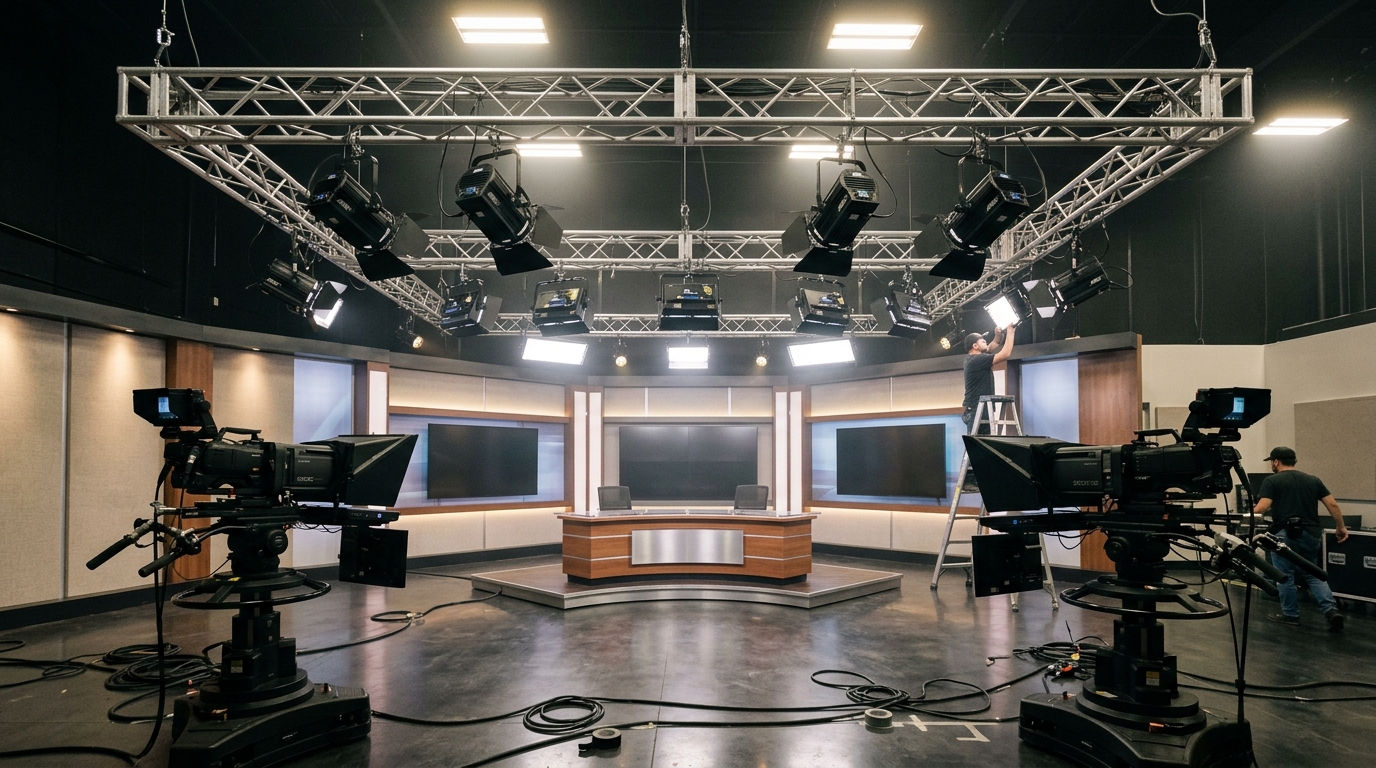
1. Why LED Stage Lighting Is Essential for TV and Film Production
In broadcast television and cinema, lighting does far more than illuminate a subject—it defines visual depth, preserves natural skin tones on camera sensors, and establishes narrative mood. Over the past decade, professional LED stage lighting for TV and film production has become the industry standard for four practical reasons:
Lower Power Draw and Reduced Studio HVAC Costs
Compared with legacy halogen, tungsten, and discharge lamps, high-efficiency LED arrays consume 60%–80% less electricity for equivalent usable output. In 24/7 newsrooms and multi-camera soundstages, lower wattage also reduces generator requirements on location and eases electrical load on older studio grids.
Minimal Radiant Heat on Set
Traditional tungsten rigs radiate intense infrared heat, making talent uncomfortable, melting makeup, and forcing studio air-conditioning systems to run louder—which interferes with boom microphones. LED stage lights emit negligible forward heat, keeping sets cooler and quieter during long shooting days.
Instant Bi-Color and Full-Spectrum Control
Instead of manually swapping color-correction gels or changing lamps between scenes, cinematographers and gaffers can dial seamlessly from warm tungsten (3200K) to crisp daylight (5600K), or blend rich RGBAL / RGBWW hues directly from a lighting console.
Extended Lifespan and Lower Maintenance
Quality studio LED engines are rated for 50,000+ operating hours, dramatically cutting down on bulb replacements, color drift between fixtures, and rigging downtime between productions.
2. Common Types of LED Stage Lights for Film and TV
Selecting the right fixture mix depends on whether a scene requires crisp shadows, soft wrap-around skin illumination, or dynamic background color. Below are the five core categories used on modern sets:
LED Fresnel & Studio Front Lights
Fitted with soft, zoomable optics and barn doors, studio front lights deliver smooth falloff for key lights, back lights, and classic facial modeling. For broadcast stages and live studios needing motorized positioning, fixtures such as the 400W LED Moving Head Front Light with Zoom and CTO and the M600 LED Outdoor IP65 Moving Head Front Light (CRI 90+) provide flexible beam control and high color fidelity indoors and on location.
LED Profile & Framing Spotlights
LED Profile & Framing Moving Head Lights feature precision optics, multi-blade framing shutters, and gobo slots. Production teams rely on models like the 800W LED Profile Moving Head with 8-Blade Framing for sharp beam cuts, anchor-desk keying, architectural texture projection, and preventing spill light onto LED video walls.
LED Moving Head Wash Lights
When a live broadcast, talk show, or variety stage demands rapid repositioning between segments, LED Wash Moving Heads & Bee Eye Lights deliver smooth zoom coverage, motorized pan/tilt recall, and saturated backdrop washes without sending crew up ladders.
LED PAR & COB Front Lights
Compact, lightweight, and easy to conceal behind set pieces, LED PAR Lights & Audience Blinders—including studio-friendly COB units like the 4 x 50W COB LED PAR Front Light—provide economical uplighting, set accentuation, cyclorama toning, and portable fill light for location shoots.
LED Pixel Bars & Strobe Effects
For music videos, award broadcasts, esports arenas, and stylized commercial shoots, LED Strobe Lights & Pixel Matrix Lights such as the 960-Pixel 120-Zone RGB LED Strobe Bar create individually addressable chases, camera-visible eye-candy graphics, and synchronized rhythmic accents.
| Fixture Category | Optical Character | Primary Role on Set | Best-Fit Production Space |
|---|---|---|---|
| LED Fresnel / Front Light | Soft edge, adjustable zoom beam | Key light, fill light, hair/back light | TV studios, narrative film, interviews |
| LED Profile / Framing | Hard edge, framing shutters, gobos | Precision keying, set texture, spill control | News desks, broadcast stages, theaters |
| LED Moving Head Wash | Motorized pan/tilt, wide zoom wash | Dynamic color washes, multi-segment shows | Variety TV, live broadcast, talk shows |
| LED PAR / COB Light | Compact, fixed or narrow wash | Set uplighting, accents, compact fills | Location shoots, small studios, backdrops |
| LED Pixel Bar / Strobe | Linear pixel-mapped / high-impact bursts | Eye-candy visuals, kinetic effects | Music videos, live TV specials, commercials |
- 400W LED Moving Head Front Light with Zoom and CTO
- M600 LED Outdoor IP65 Moving Head Front Light (CRI 90+)
- LED Profile & Framing Moving Head Lights
- 800W LED Profile Moving Head with 8-Blade Framing
- LED Wash Moving Heads & Bee Eye Lights
- LED PAR Lights & Audience Blinders
- 4 x 50W COB LED PAR Front Light
- LED Strobe Lights & Pixel Matrix Lights
- 960-Pixel 120-Zone RGB LED Strobe Bar
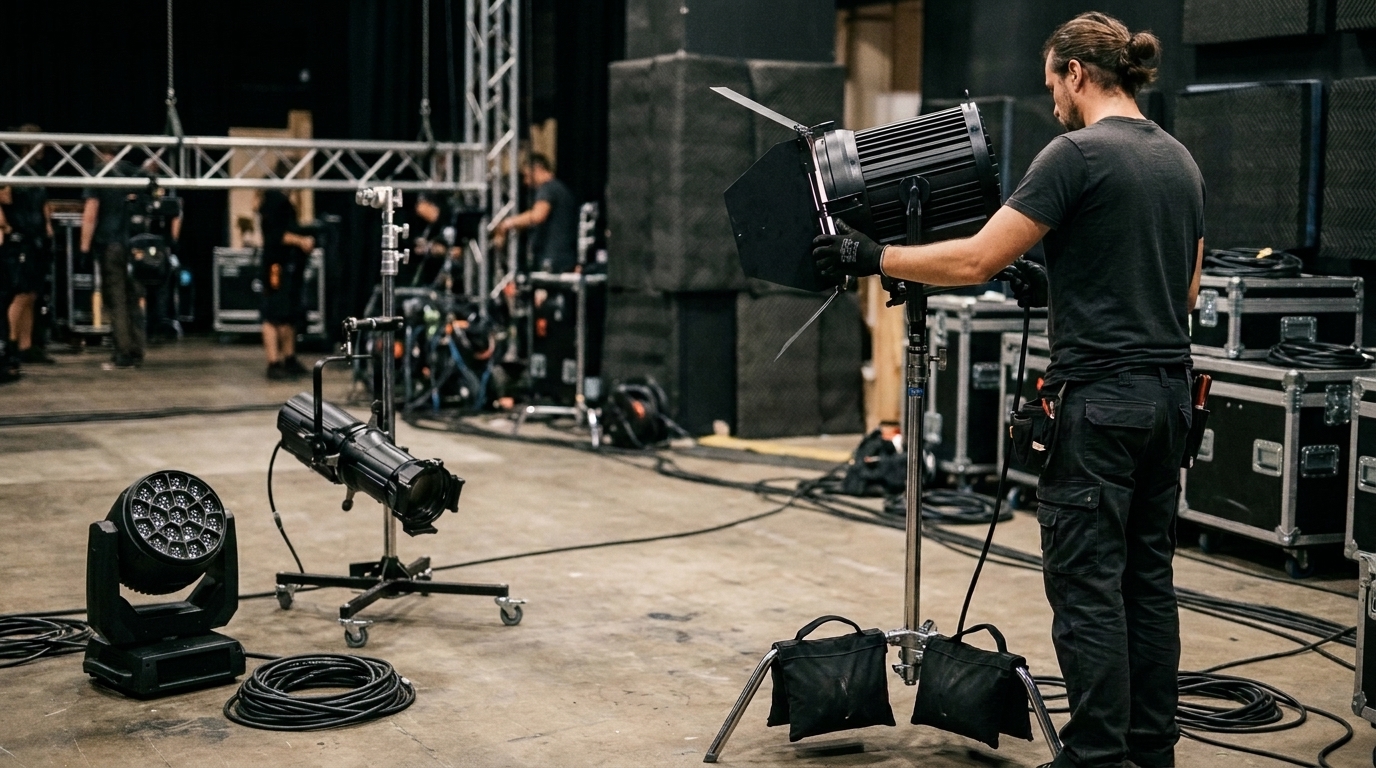
3. Key Features to Consider When Choosing LED Film Lights
Not every concert or club fixture is suitable for cinema cameras. Digital image sensors expose flaws—such as spectral spikes, PWM banding, or stepped dimming—that are invisible to the naked eye. Evaluate every fixture against these five broadcast-grade standards:
1. High CRI, TLCI, and R9 Color Fidelity
Look for CRI ≥ 95 and TLCI ≥ 95 (and at minimum CRI 90+ for secondary front washes), alongside a strong R9 (deep red) score above 90. While CRI measures human visual perception, TLCI (Television Lighting Consistency Index) specifically evaluates how a light source renders on broadcast camera sensors—ensuring accurate skin tones and reducing post-production color grading time.
2. True Flicker-Free Operation for High-Speed Cameras
Inexpensive LED drivers use low-frequency Pulse Width Modulation (PWM) that causes rolling horizontal bars on camera. Professional LED stage lights offer adjustable high-frequency PWM (up to 16,000 Hz – 25,000 Hz) so footage stays completely flicker-free across standard 24/25/30/60 fps frame rates and slow-motion high-shutter shoots.
3. Wide CCT Range with Green/Magenta (+/- G/M) Tint Control
Beyond standard 3200K–5600K bi-color tuning (or extended 2700K–6500K), look for ±Green/Magenta tint adjustment. This allows lighting directors to match mixed ambient light, practical studio fixtures, or daylight streaming through windows without green casts.
4. Smooth 16-Bit Dimming Curves
Broadcast fades require clean transitions down to 0% with zero stepping at the bottom end. Choose fixtures equipped with 16-bit dimming, selectable dimming curves (linear, exponential, logarithmic, S-curve), and optional tungsten-redshift emulation.
5. Ultra-Quiet or Fanless Cooling Systems
Dialogue recording leaves zero margin for fan noise. Studio-grade fixtures use oversized heat sinks, smart temperature-controlled fans, and dedicated Silent / Studio Modes operating below 25–30 dBA at 1 meter.
| Specification | Recommended Studio Standard | Why It Matters on Camera |
|---|---|---|
| CRI / TLCI / R9 | CRI ≥ 95, TLCI ≥ 95, R9 ≥ 90 | Prevents dull or greenish skin tones under digital sensors |
| PWM Refresh Rate | Selectable 1,200 Hz – 25,000 Hz | Eliminates rolling shutter flicker & banding in slow motion |
| Color Temperature | 2700K–6500K (min. 3200K–5600K) + ±G/M | Matches tungsten, daylight, and mixed location sources |
| Dimming Resolution | 16-bit smooth dimming (0–100%) | Ensures seamless on-air fades without low-end flicker |
| Acoustic Noise | ≤ 28 dBA in Studio/Silent Mode | Protects clean dialogue capture with lavalier and boom mics |
4. How to Build a Camera-Ready Lighting Setup
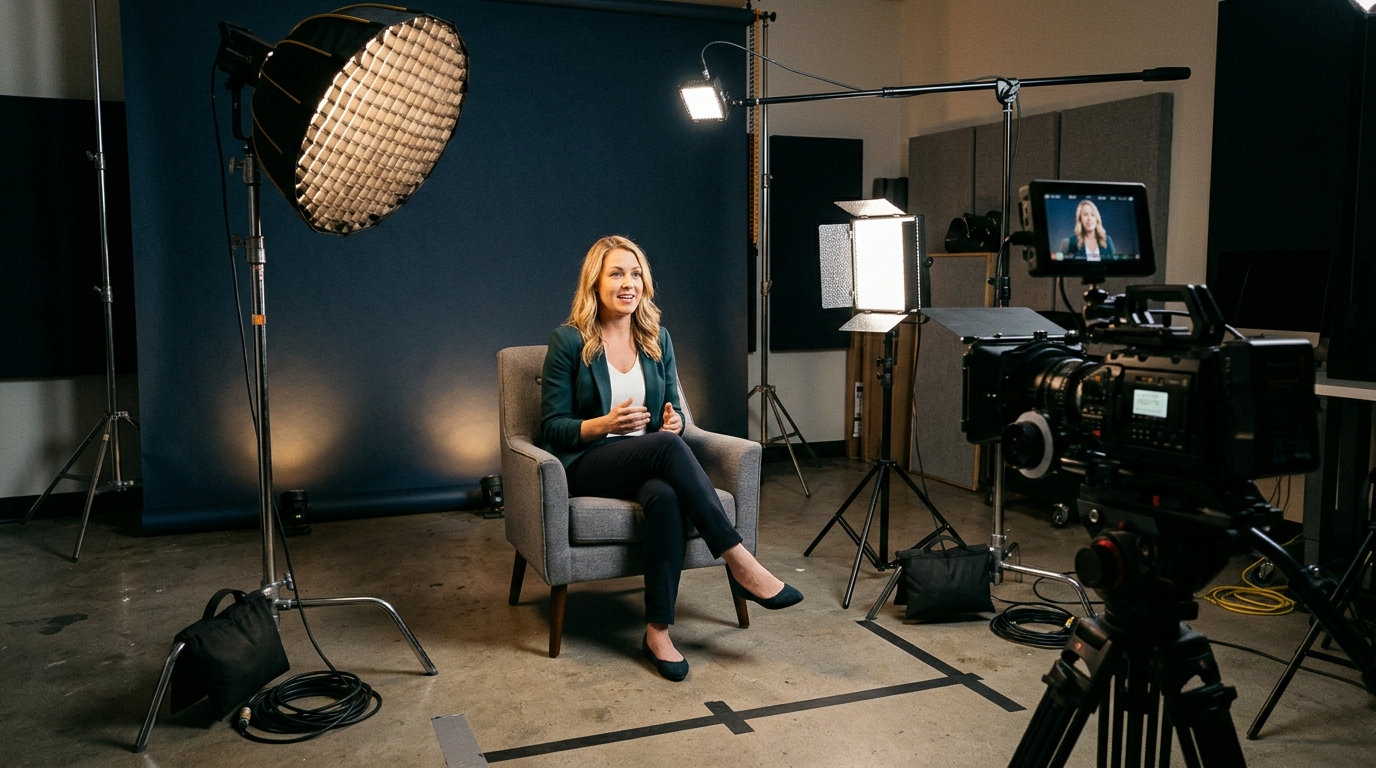
Even the best fixtures require intentional placement. Most TV studios and film crews start from the three-point lighting foundation and layer background fixtures for depth:
- Key Light (Primary Source): Positioned roughly 30°–45° off the camera axis and slightly above eye level, a diffused front light or LED Fresnel establishes the primary exposure and facial modeling.
- Fill Light (Contrast Control): Placed opposite the key light at lower intensity (typically 25%–50% of key output), a softer LED wash or diffused fixture lifts harsh shadows without flattening the image.
- Back Light / Hair Light (Subject Separation): Mounted behind and above the subject—often using a shuttered LED profile spotlight or barn-doored front light—this creates a subtle rim edge that separates talent from dark sets or green screens.
- Background & Accent Lighting: LED PARs, moving head washes, or pixel bars paint cycloramas, highlight set architecture, and add subtle color contrast (e.g., cool blue background against warm 3200K key lighting) to give 2D footage a three-dimensional look.
Pro Tip for LED Video Walls (Virtual Production / XR): Keep frontal key lights shaped tightly with 4-blade or 8-blade framing shutters so stray spill light does not wash out contrast on background LED screens.
5. Core Applications Across Broadcast and Cinema
TV Broadcasting & News Studios
Multi-camera newsrooms, talk shows, and sports desks demand rock-solid color consistency across dozens of fixtures running 12–24 hours daily. High-CRI LED front lights, silent framing profile spotlights, and motorized washes allow instant cue recalls between morning, evening, and special-event broadcasts.
Narrative Film & Independent Cinema
Film gaffers prioritize compact rigging, low-draw power options on location, and full-spectrum RGBWW/RGBAL or CMY+CTO engines capable of simulating candlelight, sodium-vapor streetlights, or moonlit exteriors in seconds.
Commercial & Product Video Production
High-speed tabletop and beauty commercials often shoot at 120 fps or higher. Flicker-free high-frequency LED lights with exact color reproduction ensure brand packaging, fabrics, and cosmetics look true-to-life right out of the camera.
Music Videos & Live Televised Performances
Music productions merge theatrical energy with broadcast camera standards—combining high-CRI front key lighting for performers with dynamic moving head washes, pixel bars, and synchronized DMX/Art-Net light shows in the background.
6. The Future of LED Lighting in TV and Film Studios
Studio lighting technology continues to evolve rapidly alongside modern cinema cameras and virtual production workflows:
- Networked & Wireless Control Ecosystems: Beyond classic DMX512 and RDM (for remote addressing and thermal monitoring), modern studios increasingly adopt Art-Net, sACN, and CRMX wireless DMX for faster rigging and centralized console diagnostics.
- Multi-Chip Spectral Engines: Advanced 5-in-1 and 6-in-1 LED arrays (RGBAL, RGBWW, RGBL) expand color gamut while maintaining broadcast-grade white light quality across the entire CCT curve.
- Virtual Production & Pixel-Driven Integration: Studios using ICVFX LED volumes now synchronize overhead LED fixtures directly with video-wall pixels so real-time reflections and ambient bounce match virtual environments seamlessly.
- Sustainability & Green Production Standards: Broadcasters and streaming studios are adopting strict carbon-reduction targets, making high-efficacy, long-life LED rigs a core requirement for eco-certified productions.
7. Conclusion
Upgrading to professional LED stage lighting for TV and film production empowers studios and production crews with cleaner color reproduction, lower power and cooling overhead, faster scene changes, and rock-solid on-camera reliability. By matching the right fixture mix—front lights, framing profiles, washes, and pixel effect bars—to strict broadcast benchmarks like CRI/TLCI 95+, high-frequency flicker-free dimming, and whisper-quiet operation, your team can deliver consistent, broadcast-ready visuals on every shoot.
Looking to upgrade your broadcast studio, rental inventory, or film production lighting package? Explore YL Light's Stage Lighting Catalog or Request a Custom Studio Lighting Proposal & Free Quote from our engineering team today.
8. Frequently Asked Questions (FAQ)
01What CRI and TLCI rating do I need for TV and film LED lighting?
For professional broadcast television and narrative film, choose LED fixtures with CRI ≥ 95 and TLCI ≥ 95 (and R9 ≥ 90). Ratings of 90+ are acceptable for secondary background washes or outdoor front lights, while primary studio key and fill lights hitting human skin should meet 95+ standards to avoid color shifts on camera.
02How do I make sure LED stage lights will not flicker on camera?
Verify that the fixture features a flicker-free constant-current driver with selectable high-frequency PWM (at least 3,000 Hz for standard broadcast frame rates, and 16,000 Hz–25,000 Hz for slow-motion or high-shutter commercial shoots). Always perform a quick camera shutter test during pre-lighting.
03What is the difference between LED Fresnel front lights and LED profile spotlights?
LED Fresnel and studio front lights produce a soft-edged beam that blends naturally across faces and sets, making them ideal for key, fill, and back lighting. LED profile (framing) spotlights produce a crisp, hard-edged beam with internal framing shutters and gobo holders for sharp cuts, podium lighting, and patterned projections.
04Are LED stage lights quiet enough for live studio audio recording?
Yes—provided you select studio-rated LED fixtures rather than loud concert fixtures. Look for models offering passive/fanless cooling or a selectable Silent/Studio fan mode rated below 28–30 dBA so overhead fixtures remain inaudible to boom and lavalier microphones.
05Can LED stage lights match natural daylight or legacy tungsten fixtures?
Yes. Bi-color and full-spectrum studio LEDs smoothly adjust from 3200K (tungsten) to 5600K (daylight)—and often wider—while fixtures with +/- Green/Magenta tint control can match almost any existing studio or practical light source on set.
Read this guide in your language