The starting point
Plan a sound system around audience coverage, programme requirements and the venue. Establish the loudspeaker arrangement, subwoofer layout, processing and amplification as a complete system. Cabinet quantity and a single maximum-SPL figure cannot by themselves confirm whether an array will suit an event.
1. Describe the audience area
Provide a scaled plan showing audience width and depth, seating or standing areas, stage position, balconies, obstructions and available loudspeaker locations. Include mounting heights and the distance to the nearest and furthest listeners. For an indoor venue, room construction and reverberation also influence intelligibility.
State whether the programme is speech, live music, DJ playback or a combination. Describe the required operating level and any site limits. These inputs help a qualified system designer evaluate coverage, headroom and the possible need for front fills, delays or other loudspeaker types.
2. Verify the exact loudspeaker configuration
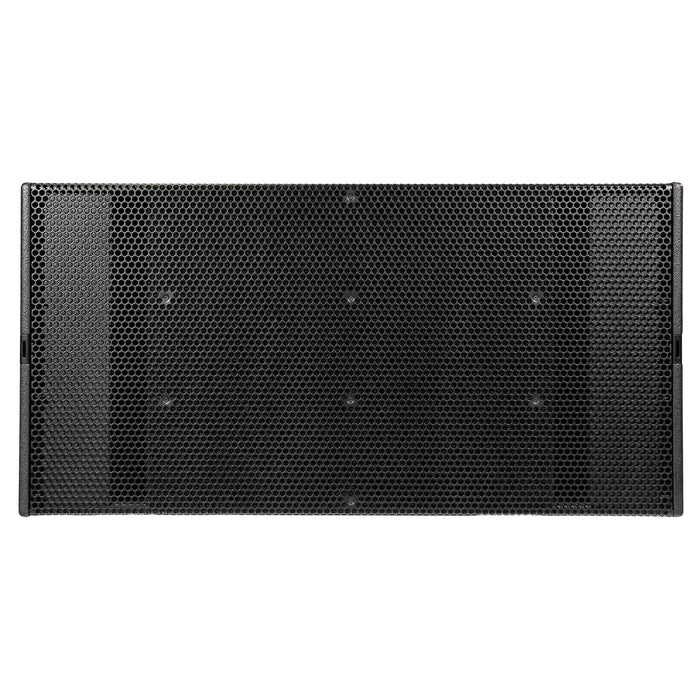
Confirm the precise model and variant, driver configuration, coverage data, frequency range and documented operating limits. Active and passive versions require different system arrangements. A specification such as peak power, programme power or AES power describes a particular rating method; values from different methods are not directly interchangeable.
Ask how published maximum-SPL values were established and whether the manufacturer supplies suitable prediction data and setup guidance. Array length, cabinet angles and placement affect coverage. Do not infer the required number of cabinets from photographs of another event.
3. Plan the subwoofers as part of the system
Subwoofer quantity and placement depend on the programme, desired low-frequency extension, audience geometry and available space. Consider sightlines, stage access, physical security and site boundaries. Ground-stacked, separated and directional layouts have different design implications.
A cardioid arrangement needs compatible equipment, correct placement and appropriate processing. It is not achieved by simply turning one cabinet around. Confirm the supported configuration and the required delay, polarity, filtering and level settings with the system designer or supplier.
4. Confirm the signal and power chain
- For passive systems, check amplifier compatibility, load impedance, channel allocation and speaker cabling.
- For active systems, confirm mains supply, distribution, audio connections and any control-network requirements.
- Request the exact processing presets, crossover settings, protection limits and supported firmware or processor versions.
- Identify the mixer outputs, system processor, measurement equipment and person responsible for alignment and commissioning.
5. Treat rigging and commissioning as project requirements
Use only the documented, compatible rigging components for the specific cabinet model. A qualified rigger or structural professional must verify loads, suspension points, configuration limits and the supporting structure. A product’s lifting accessories do not establish the capacity of a venue roof or temporary structure.
For a useful quotation, send the venue plan, programme type, proposed positions, indoor or outdoor conditions, available power, existing equipment and destination. Request an itemised system proposal covering cabinets, amplification or active electronics, processing, rigging, cables and transport. Keep commissioning time in the plan: coverage, delay, polarity and level need to be checked on site. Resolve conflicting model descriptions before committing to an order.
Common questions
How many line array cabinets do I need?
There is no reliable universal cabinet count. Audience geometry, available mounting height, the chosen model, programme and operating level determine the design. Provide a venue plan so a qualified designer can assess the arrangement.
Can any subwoofer be used in a cardioid layout?
Do not assume compatibility. Confirm that the model and processing support the intended layout, then follow the documented placement and alignment requirements. Performance must be checked for the actual setup.
Ready to apply this to your project? Share the model shortlist and the details you have gathered.